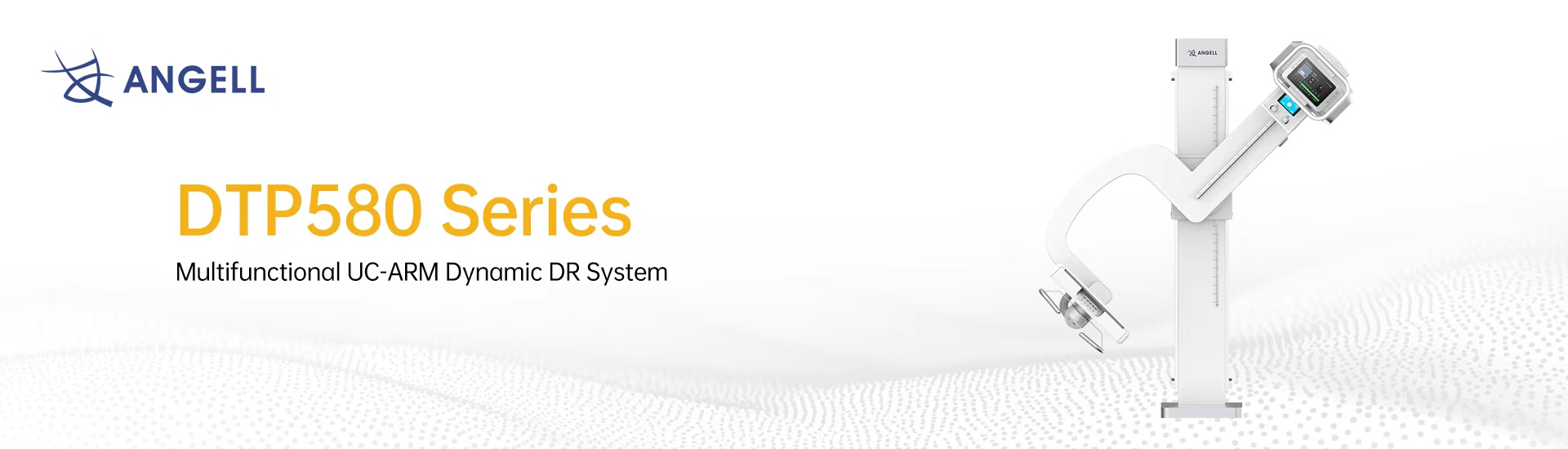
Tube and flat panel detector ride opposite ends of one rigid arm — so the equipment turns around the patient, and upright, supine, lateral and oblique projections all come from a single geometry.
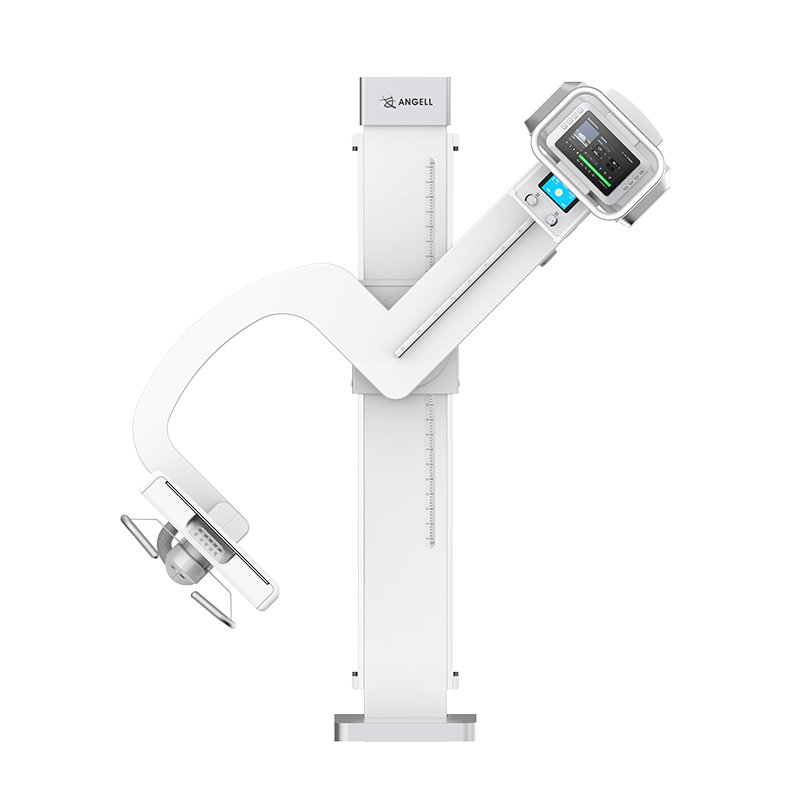
Angell's UC-arm platform for departments that run a wide mix of examinations from a single room. Both the detector and the horizontal arm rotate, so specialised projections are set up on the equipment rather than negotiated with the patient — and a dual-control system keeps positioning and exposure in step.
The name describes the shape. The arm curves from the tube head, around the patient space, to the detector — a U at rest, a C once it rotates. That one structure is what separates arm-mounted radiography from rooms where the tube and the receptor are installed as two independent pieces of equipment.
Because the arm holds both ends in permanent alignment, source-to-image distance and centring arrive already correct with every position the operator selects. Changing the projection means rotating the arm, not moving the patient — which is why the geometry is chosen for rooms where the next case is rarely like the last one. Angell introduced the world's first UC-arm dynamic DR with a flat panel detector in 2014, and builds its own detectors, X-ray tubes and high-frequency high-voltage generators.
Both produce diagnostic images. They differ in what has to happen when the projection changes — and that difference decides which room fits your case mix.
| UC-ARM Dynamic DROne arm · aligned pair | Fixed Two-Part RoomSeparate tube & receptor | |
|---|---|---|
| Tube–detector relationship | Locked by the arm; the pair moves as one unit | Two independent supports, aligned per examination |
| Changing projection | Rotate the arm; the patient holds position | Patient is repositioned between table and stand |
| Angled & specialised views | Reached through arm and detector rotation | Depend more on patient posture and manual setup |
| Room footprint | One structure with a defined rotation envelope | Table and stand each claim their own floor area |
| Best suited to | Broad, unpredictable case mix in a single room | Standardised, repeating projection lists |
Neither is a replacement for the other. The question is whether the room's value comes from repeatable throughput or from positional range.
Multi-position capability matters most where the next case is not like the last one. These are the settings where UC-arm geometry is specified.
Long lists, short slots, a different view almost every time — the arm absorbs the variety so one room covers it.
Pneumoconiosis screening at volume, with self-developed image processing built for that protocol.
Patients who cannot stand, sit or turn on request keep their position while the arm comes to them.
Joint and limb imaging depends on angle — and angle is what an arm gives you.
If the deciding factor is where the equipment lives, how it is installed, or which examination type it must serve, another category will fit better.
Tell us the case mix, the room dimensions and the country you are installing in — our team will come back with configuration, documentation and pricing.

Angell Technology established in 2002, is a global professional digital medical imaging equipment supplier.
Copyright © 2026 Angell Technology, All Right Reserved